
Summary
In the summer of 2025, a pilot programme comprising a series of cervical length ultrasound education days was introduced in the Thames Valley Deanery to support best clinical decision-making in identifying pregnancies at increased risk of preterm birth. The aim of this initiative is to improve prediction and prevention of preterm birth and optimise the condition of babies born too soon, making sure they receive the right care in the right place at the right time. This approach should also reduce avoidable transfers to hospitals with specialist newborn care services and unnecessary hospital admissions, optimising access to high-risk maternity beds and services for highest-risk pregnancies.
By the time the pilot ended in February 2026 it had enabled 46 NHS maternity doctors to perform a cervical ultrasound scan, improving round-the-clock access to this test in acute settings, such as maternity triage. Until now, these scans were only undertaken by specialists in fetal medicine units and sonographers in outpatient maternity ultrasound settings.
This initiative was made possible by the generosity of more than 250 pregnant volunteers and the support of preterm birth specialists. The collaborative programme is coordinated by the Maternity and Neonatal Patient Safety team at Health Innovation Oxford and Thames Valley (HIOTV), which is commissioned by NHS England to implement the preterm birth optimisation pathway. HIOTV is now considering the sustainability and longevity of this innovative project. Data is being gathered to assess its impact on preterm birth prediction and prevention.
This pilot was shortlisted in the Early Stage Innovation category of the Health Service Journal Patient Safety Awards 2026.
Opportunity identified
Preterm birth is a significant healthcare challenge globally, is the biggest single cause of neonatal mortality in the UK and a leading contributor to deaths in childhood. Over the last decade successive UK governments have committed to reduce preterm births. NHS England’s Saving Babies Lives Care Bundle (updated in 2023) sets out a range of interventions aimed at improving outcomes for these babies, including cervical length scanning.
An ultrasound scan measuring the length of the cervix is the most effective way of identifying those at increased risk of giving birth prematurely. This scan is currently only available as a screening test to asymptomatic women with known risk factors for preterm birth, even though approximately two-thirds of preterm births occur in pregnancies with no known risk factors for preterm birth.
The pilot programme was designed for resident doctors in obstetrics and gynaecology. It aimed to strengthen the prediction of spontaneous preterm birth through targeted learning and use of the nationally recognised and accredited QUiPP app. The QUiPP app previously utilised a point-of-care test called Fetal Fibronectin (fFN) to quantify the risk of preterm birth. However, the production of fFN has been discontinued internationally.
The new course aims to address this gap in care in an acute situation. As a result of acquiring this new skill, doctors will be able to generate an individualised risk of preterm birth between 16 and 34 weeks of pregnancy. Ultimately, this will support best clinical decision-making and improve outcomes.
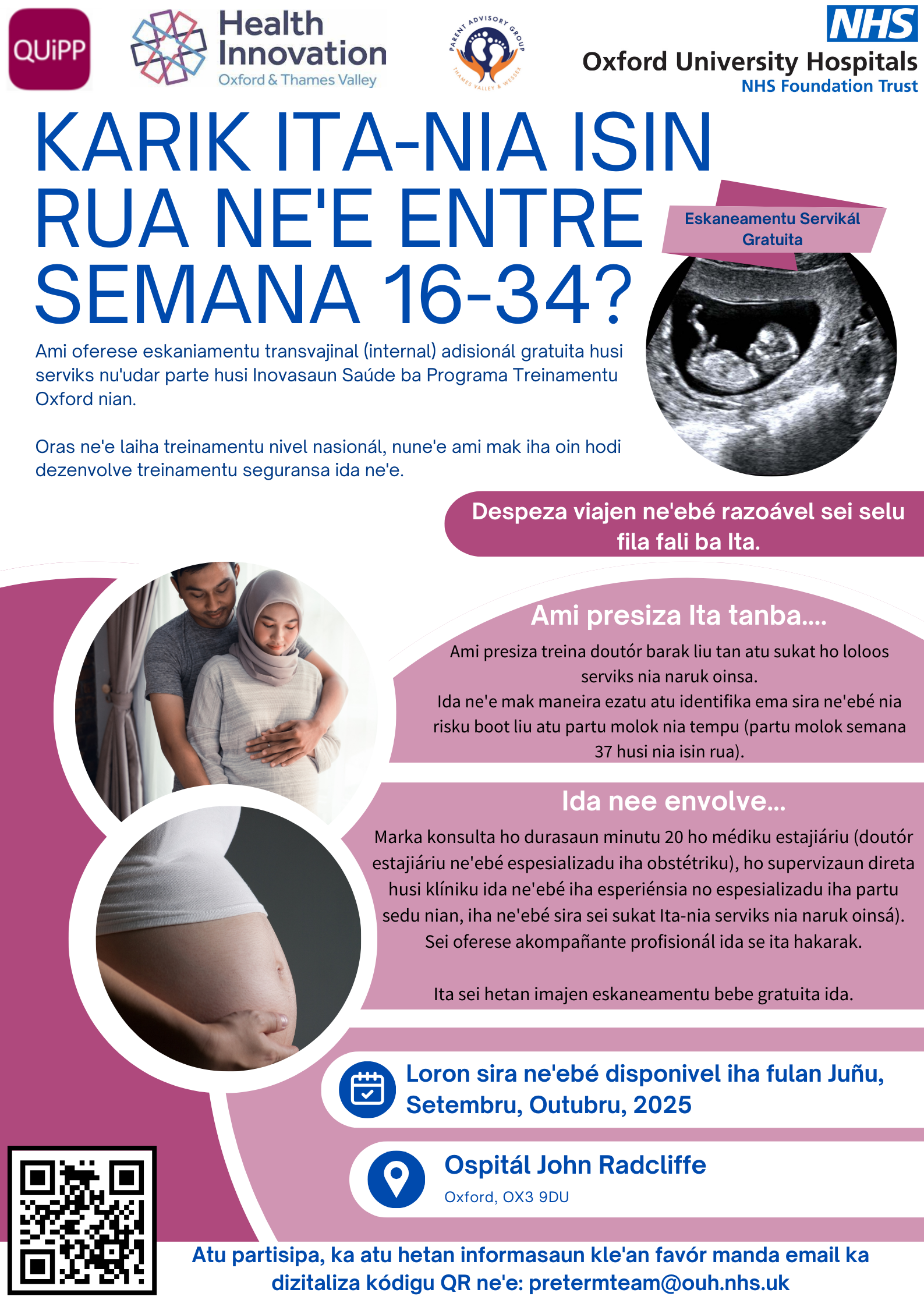
Poster seeking volunteers in Tetum language
Alignment with government priorities
- Treatment to prevention – preventing preterm birth is better than optimisation.
- Hospital to community – admitting and discharging the right patients.
- Health inequalities – Preterm birth rates are highest among Black babies (8.7%) and second highest among Asian babies (8.1%) in England and Wales (2021). The rate in the overall population in 2021 was 7.6%. In this initiative we made a concerted effort to reach a broad and diverse cross-section of the pregnant population. This included using social media platforms such as Facebook and translating recruitment posters into the most common languages in each catchment area. The posters were translated into six languages, including Urdu and Tetum (spoken by people from East Timor).(source: House of Lords Birth Committee July 2024 / MBRRACE-UK State of the Nation Report (covering data for 2021-2023)
Network support
The Maternity and Neonatal Patient Safety team at HIOTV secured funding to support this pilot and developed it with obstetricians, midwives and other experts in preterm birth. Recruitment of pregnant volunteers is a key element of the programme, and we are grateful to the Neonatal Parent & Family Engagement Lead, Thames Valley and Wessex Operational Delivery Network, and to the Specialist Midwife for Equality, Diversity and Inclusion at who co-produced the recruitment posters with us (see example, right). The HIOTV team co-ordinated and evaluated feedback from each day, and engaged with partner organisations to share and promote this innovative project.
 Impacts to date

6 education days between June 2025 and February 2026
2 NHS locations: Oxford University Hospitals (John Radcliffe) and Buckinghamshire Healthcare (Stoke Mandeville)
46 obstetrics and gynaecology resident doctors certified to carry out an additional cervical scan
250+ pregnant volunteers contributed real world experience
Scalability/Next steps
This pilot programme has supported the consolidation of the use of point-of-care ultrasound in clinical practice and has the potential to become a sustainable intervention in preterm birth prediction and prevention. It has contributed towards accelerating early competence, reducing variability in clinical practice and, ultimately, improving maternity care for women who are at increased risk of preterm birth.
This initiative has identified a clear gap between the skills that resident doctors in obstetrics and gynaecology are increasingly expected to use in modern clinical practice and those formally embedded within the Royal College of Obstetrics and Gynaecology (RCOG) competency-based training. As point-of-care-ultrasound is an essential component of safe, individualised patient-centred care, it is increasingly important to introduce cervical length ultrasound assessment as a routine component of the RCOG training curriculum.
External clinicians were able to observe the education days. Other regions are now establishing their own programmes based on the HIOTV model.
Data is being gathered to assess the impact of the pilot programme on preterm birth prediction and prevention. An implementation pack is also being developed.
Feedback quotes from patients and participants

Jenny Anslow
“It was really reassuring that everything is ok with my cervix at this stage of my pregnancy.” – Pregnant volunteer Jenny Anslow (pictured, left)
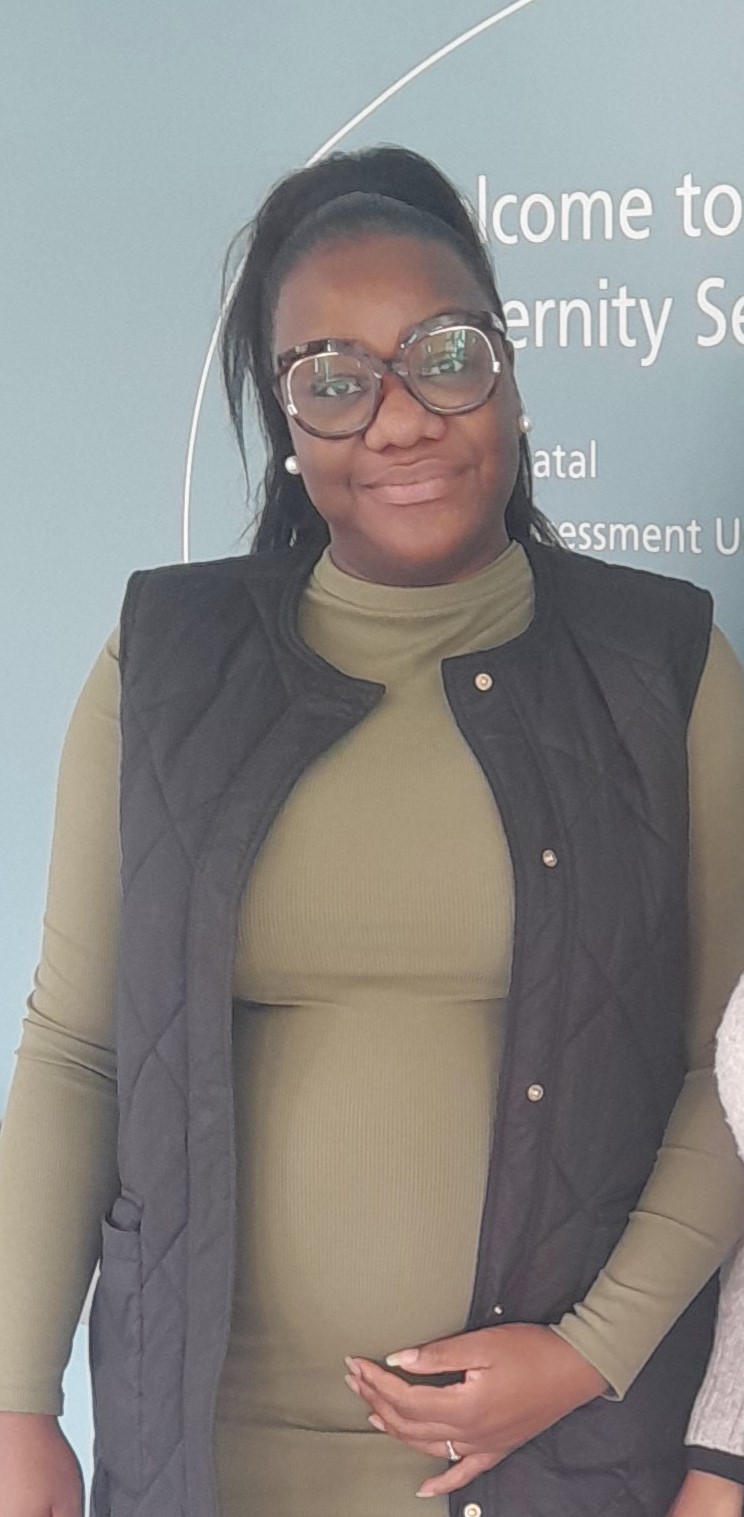
Senzeni Nyoko
“I volunteered through seeing the patient recruitment poster on Facebook. I was keen to support the training/research. I also wanted to get some advice about the procedure as I have never had an internal scan before – so was unsure what to expect.” – Pregnant volunteer Senzeni Nyoko (pictured, right)
“I was attending another appointment and noticed the Romanian translated poster in the patient lifts. It grabbed my attention as it was offering a free scan. I thought having an additional scan would help with my fear of things ‘going wrong’.” – Pregnant volunteer Irina Popa
“It was so beneficial to be able to have the opportunity to scan real patients with real-time feedback from experienced senior clinicians. I learnt a lot, and this will certainly have a positive impact on how I manage patients.” – Dr Elizabeth Kostov, Oxford University Hospitals
“This programme is a great example of effective collaboration across our region.” – Dr Aparna Reddy, Consultant in Obstetrics and Fetal Medicine, Buckinghamshire Healthcare
“This pilot is equipping our teams with the skills to identify women at risk of preterm birth earlier and more accurately, helping us to provide safer, more personalised care. By improving decision making at the point of care, we can reduce unnecessary transfers and ensure that women receive the right support in the right place at the right time.” – Andrew McLaren, Chief Medical Officer at Buckinghamshire Healthcare