
Summary
Sepsis is a life-threatening condition that arises when the body’s response to an infection injures its own tissues and organs, with the immune system going into overdrive. In the UK, there are 48,000 sepsis related deaths each year – that’s about five people every hour (The UK Sepsis Trust). There is no single, definitive test to diagnose sepsis. Health Innovation Oxford and Thames Valley (HIOTV) conducted a feasibility study evaluating the LIT™ Sepsis Test, a novel point-of-care diagnostic developed by Seroxo, to support early detection and monitoring of sepsis. Interviews with senior NHS clinicians highlighted the limitations of current tools such as NEWS2 and expressed cautious optimism about LIT™ as a complementary tool, particularly for patients with ambiguous presentations. We also gathered feedback from patients. Further clinical and economic evidence is required prior to adoption.
What is the challenge?
Sepsis remains a major cause of avoidable harm, mortality, and litigation in the NHS. It is life-threatening and leads to approximately 245,000 hospital admissions within the UK each year (The UK Sepsis Trust). There is no single, definitive diagnostic test for sepsis. Reliance on physiological scoring systems can lead to missed diagnoses or overtreatment. There is a need for rapid diagnostic support tools to improve risk stratification, guide treatment decisions and optimise NHS resources. The LIT™ Sepsis Test is a rapid point-of-care test that measures neutrophil function from a finger-prick blood sample in approximately ten minutes, supporting early sepsis detection as well as monitoring response to treatment.
What did we do?
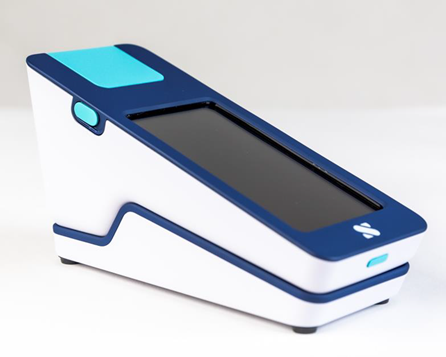
Seroxo’s LIT™ Sepsis Test
HIOTV led the study design, delivery and analysis, patient and public member involvement, and supported stakeholder engagement across multiple NHS trusts.
We conducted a feasibility study to assess the acceptance, perceived usefulness and potential barriers to adoption of the LIT™ test within NHS A&E and AMU departments, using the Lean Assessment Process (LAP) methodology. LAP is a structured framework integrating both qualitative and human factors approaches to assess the clinical relevance and implementation potential of emerging technologies. Interviews were conducted with 11 stakeholders working in A&E and AMU services across eight NHS trusts. Their insights were thematically analysed to understand the perceived benefits and barriers to adoption of the LIT™ test.
We incorporated clinician and public involvement through several workshops. These revealed critical insights about the importance of timely and clear information sharing. Patients expressed frustration over the lack of communication, with one stating, “The consultant said, ‘you are lucky to be alive.’ I didn’t want to hear this. It was frightening.” Clinicians acknowledged the need for sensitive communication, emphasising that health literacy must be considered. Both groups showed optimism about the potential of the LIT™ test to improve diagnosis, while also raising concerns about its accuracy and practical implementation.
What has been achieved?
Our feasibility study demonstrated the potential for earlier and more accurate identification of sepsis risk using LIT™. If validated, it could support:
- Timely decision-making, leading to prompt treatment
- Improved patient monitoring
- Consistent management of sepsis across NHS pathways.
Clinicians indicated that the LIT™ test could be cost-effective if it reduces unnecessary admissions, length of stay, or inappropriate antibiotic use, particularly when targeted to selected patient groups rather than blanket screening.
Both clinicians and patients saw potential value in the LIT™ test as a diagnostic support tool. Further studies exploring its integration with existing workflows and guidelines, and potential economic impact, are also planned.
Scalability/next steps
Our findings will enable Seroxo to better understand the value proposition and barriers to adoption of the LIT™ test in A&E and AMU settings and serve as a roadmap for continued development towards adoption in the sepsis pathway. Further pilots in other settings such as Intensive Care Units will explore the test’s usefulness in other NHS pathways.
What they said

“HIOTV delivered an outstanding feasibility study for Seroxo’s LIT™ test, applying the Lean Assessment Process with rigour, insight and professionalism. Their team was highly responsive and collaborative, engaging clinicians and patients across multiple NHS trusts to generate meaningful real-world feedback. The thematic analysis was thorough and balanced, clearly identifying both opportunities and barriers to adoption. Importantly, their clinician and public involvement workshops surfaced valuable insights around communication and implementation that will directly inform next steps. HIOTV’s work has significantly strengthened our clinical strategy, and we would highly recommend them to any organisation developing innovative healthcare technologies.” David Sarphie, CEO, Seroxo
Contact
Florence Serres, Project Manager, florence.serres@healthinnovationoxford.org