

I cannot imagine what it must be like not knowing where I am going to sleep tonight – or the next, or how I am going to find food so that I am not constantly thinking about it. Or more to the point, why I would find the time to talk to anyone about health data. But we found that people in this situation generously did so, knocking my preconceptions out of the water.
This week is Co-production Week, a good time to focus on our report ‘Food, Safety, then Data: Attitudes to Healthcare Data for Planning & Research’ which captured the views of people with lived experience of homelessness.
We already know that people experiencing homelessness have poorer health and face numerous barriers to getting the care they need. Stigma, exclusion and disrespect affect trust in services and, potentially, willingness to share health and care data. Some of their feedback is captured in this short animation. I am not easily shocked, but hearing that air freshener was sprayed in someone’s face was shocking (from 01.17 in the animation).
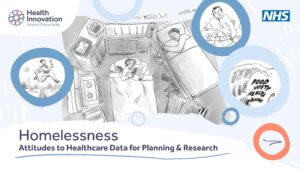 Despite such experiences, it turns out that people experiencing homelessness are generous and not unhappy for their data to be used for research and planning. Once people understood what their data could be used for, especially helping people like themselves, they said that it would be ok for their data to be used. Taking the leap of faith that as individuals we can contribute to the wellbeing of everyone.
I remain humbly thankful to the people who spent time with us, including the staff at Groundswell, many of whom also have experience of homelessness first hand. This work further highlights that trustworthy use of health and care data is inseparable from dignity, transparency, human interactions and relationships. Building trust in care is foundational to building trust in data.
Some take-aways
Data and data use
- Daily survival shapes priorities: food, safety and shelter come first. Health data feels irrelevant when basic needs are unmet. So, be mindful of context and avoid assumptions about capacity or interest in data or other conversations.
- Experiences of care directly affect trust in data and its use: poor communication, lack of privacy, inaccurate records and feeling unheard undermine trust in health and care systems and professionals. So, prioritise respectful, trauma-informed interactions and clear communication.
- Power, choice and consent matter: many homeless people feel they have little control over how their data is used and so feared misuse. Explaining choice clearly, including consent, opt-out options and how data is stored and accessed securely is important.
- Transparency enables openness: people are more willing to share data when its purpose is clear, its benefits are tangible – particularly to other people who are homeless, and data is de-identified. So, proactively explain what data is used, why, who can access it and how it benefits others.
Working with seldom heard communities
- Prioritise co-production with lived experience: a development group of people with lived experience shaped the project design, delivery and interpretation. So, involve people with lived experience from the outset as partners, not participants.
- Acknowledge lived experience and structural disadvantage: homelessness is shaped by systemic inequality and repeated negative interactions with institutions.
So, approach engagement with empathy, realism and respect for context. - Foster psychological safety: fear of judgment, or its consequences limits openness. So, make participation optional, safe and clearly explained.
- Use clear, accessible and transparent communication: use simple language, visuals, real examples and clear explanations of data use and benefit.
About the author
