
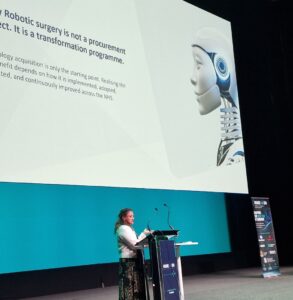
Last weekend, I spoke at Robotics, Innovation and Surgical Excellence (RISE) UK 2026 in Birmingham.
From the opening address to the final session, the event was about much more than robots. It was about how we make surgical innovation work safely, intelligently and at scale.
I presented on “Evaluating surgical robotics beyond clinical outcomes: economic, workforce and system impacts.”
One message sat at the heart of the presentation: robotic surgery is not a procurement project. It is a transformation programme.
Technology acquisition is only the starting point. Realising its full value depends on implementation, adoption, workforce development, evaluation and continuous improvement across the NHS.
That means the work does not end when the contract is signed. In many ways, that is where it starts.
Evaluate robotic surgery early, honestly and continuously
If the NHS is to understand the value of robotic surgery, evaluation needs to start before rollout.
I shared three principles for doing this well:
- Start before rollout. Engage the people who will use the technology. Test the value proposition and identify barriers to adoption while there is still time to address them.
- Understand what evidence is realistically achievable. Know what data exists, who controls it and whether the proposed study is realistic. A good evidence plan should match what can actually be delivered.
- Keep evaluating after sign-off. Evaluation should run alongside implementation rather than stop when a business case is approved. New platforms, clinical indications and surgeon cohorts can all change the picture.
NHS trusts are also at very different stages of robotic surgery adoption. Some have completed hundreds of cases while others are still considering adoption.
A shared framework can support different stages without asking every trust to start again from scratch.
The robot is only part of the transformation
The impact of robotic surgery also depends on the people using it.
New surgeons go through a learning curve as they develop their skills. Early changes in productivity need to be understood in that context.
The wider theatre team matters too. Scrub teams, assistants and nurses may all need to work differently when a robot becomes part of the pathway.
This makes workforce development an important part of implementation. It also highlights the value of shared learning between trusts.
Clinical outcomes are only part of the evidence
Clinical outcomes matter, but they cannot answer every question the NHS needs to ask about a health technology.
A broader evidence framework should consider:
- Patients: outcomes, recovery experience and patient-reported outcomes
- The workforce: how trained teams work, retention and training
- The system: real throughput once the learning curve is considered
- The NHS: reusable approaches to evaluation
- Society: productivity, sustainability and the future surgical workforce
One framework can bring these perspectives together. That is more useful than building separate cases for each audience.
From innovation to implementation in the NHS
Our Chief Executive, Professor Gary Ford, also spoke on “Driving innovation to implementation in the NHS.”
The two sessions connected around a shared challenge: how do we move from an innovation with potential to a solution that works in the NHS?
For medtech and health technology innovators, evidence is part of that journey. Rapid scaling of adoption of technology of value is key and achieving implementation beyond the innovators and early adopters where much technology stalls.
The NHS needs to understand not only whether a technology works, but how it will fit into clinical pathways, support the workforce and deliver value within the wider system.
For NHS trusts and system partners, this means considering the full change programme when assessing a new technology. Procurement is one part of the process, not the whole process.
This is important as the NHS places greater focus on value when buying medical technology. Current guidance considers wider benefits including productivity, patient experience, staff experience, the environment and supply chain resilience.
What does this mean for NHS trusts and systems?
If you are considering robotic surgery, the investment goes beyond the technology itself.
Consider the training, theatre time, data collection and evaluation needed to support implementation.
Design the evaluation approach before procurement where possible. This gives you a clearer view of the questions you need to answer and the data you need to collect.
Allow for the learning curve when assessing performance. Think about the whole theatre team, not only the surgeon using the console.
Finally, look for opportunities to use shared approaches and evidence. Repeating the same work across trusts adds effort without necessarily adding insight.
What does this mean for medtech and health technology innovators?
For innovators, the NHS is not only assessing your product. It is assessing what needs to change around it.
Show that you understand the implementation requirements your technology creates and how you will support them.
Build evidence that addresses more than clinical outcomes. Workforce and system impacts can also shape the value case.
Be clear about what you can demonstrate, when you can demonstrate it and what data you need.
Treat training and implementation support as part of the solution rather than an afterthought.
Most importantly, start the evidence conversation early. Waiting until procurement or a business case can leave too little time to answer the questions that matter.
Building the evidence for the next generation of surgical care
The question is no longer simply whether robotic surgery works. It is what kind of surgical system we build around it.
The next generation of surgical care will depend on how successfully we combine technology, workforce, evidence and implementation.
That lesson extends beyond robotics. It applies to any health technology that aims to move from innovation to adoption and deliver value for patients, staff and the NHS.
At Health Innovation Oxford and Thames Valley, our health economics team works with NHS organisations and innovators to build evidence that supports better decisions about health technology adoption.
Talk to our team by emailing info@healthinnovationoxford.org
About the author
